

You have the title. The salary. The seat at the table you worked a decade to earn. And yet, on a quiet Tuesday morning, you sit in your car before walking into the office and you feel nothing. Or worse: dread.
This is not laziness. It is not ingratitude. It is what happens when a high-achieving woman has spent years building an identity around performance rather than purpose.
The Burnout Data Nobody Is Talking About Honestly
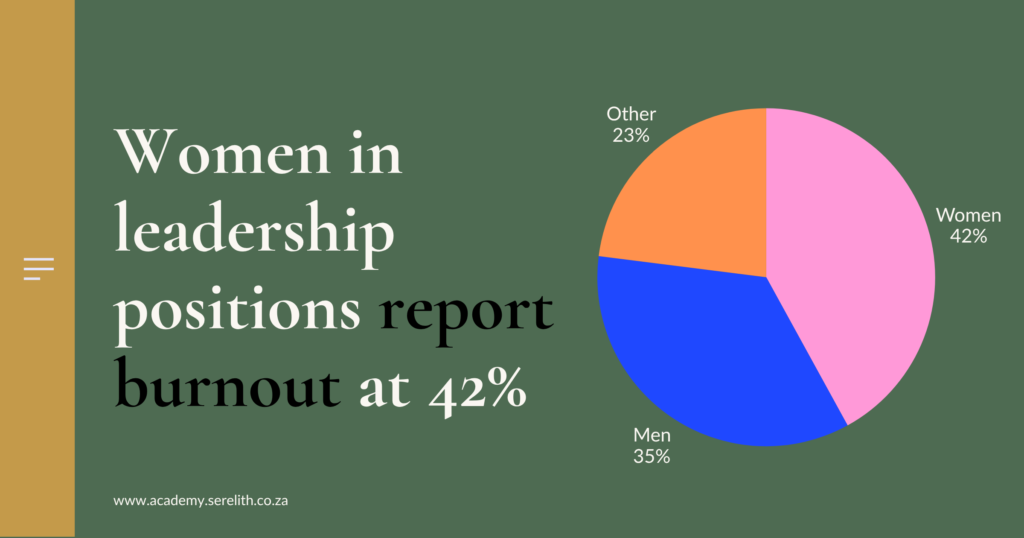
Burnout among women in leadership is not a trend, it is a crisis. Women in leadership positions report burnout at 42% compared to 35% for men, according to McKinsey and LeanIn.org’s Women in the Workplace report. And these are not women who lack discipline or drive. These are women who gave everything and then discovered that “everything” was not sustainable.
The conventional response is to prescribe rest, boundaries, or productivity tools. Take a holiday. Download a meditation app. Block your calendar. But for the high-performing woman, these interventions offer temporary relief and no structural change. Two weeks after the break, the burnout returns. Because the break did not address the root.
What the Identity Trap Actually Looks Like
The identity trap is subtle. It begins the moment you start equating your worth with your output. When your value as a person becomes inseparable from your value as a professional, rest feels dangerous. Slowing down feels like falling behind. Saying no feels like a failure of character.
For many high-achieving women, this pattern begins early. Research on self-concept clarity shows that when a person’s sense of self becomes tightly bound to professional performance, self-concept clarity, the degree to which we know who we are drops significantly, leaving individuals more vulnerable to burnout and less able to sustain their working state over time.
This is not ambition. This is armour. And it will exhaust you.
Imposter syndrome compounds this further. A KPMG study of 750 high-performing executive women found that 75% had experienced imposter syndrome at some point in their careers. The result is a cruel paradox: you work harder to prove you belong, but the harder you work, the more your identity depends on the work and the more devastating any stumble becomes.
Why Productivity Hacks Cannot Fix an Identity Problem
The wellness industry has done women a disservice by treating burnout as a scheduling problem. You cannot time-block your way out of an identity crisis.
What sustainable recovery actually requires is a fundamental recalibration, not of your calendar, but of your core narrative. Who are you when the results are not extraordinary? What do you value when nobody is watching? What version of success belongs to you, rather than to the expectations you inherited?
This is the work the Serelith Academy Reset & Reclaim programme was designed to do. Not performance optimisation. Identity reconstruction.
The Framework: Three Pillars of Identity-Based Recovery
The Reset & Reclaim methodology rests on three pillars:
Pillar One — Excavation. Before you can rebuild, you must identify which parts of your current identity were chosen and which were assigned. Many high-achieving women discover that their drive is genuine, but the specific shape of their ambition was formed by external validation rather than internal alignment.
Pillar Two — Recalibration. This is where you define success on your own terms, not in opposition to achievement, but in alignment with who you actually are. This is not a retreat from ambition. It is an upgrade.
Pillar Three — Embodiment. Knowing who you want to be is not enough. The third pillar is about building daily structures, boundaries, and practices that make the new identity operational—sustainable by design, not by willpower.
What Rewired Success Looks Like
Women who do this work do not become less ambitious. They become more strategic. They stop spending energy on proving and start spending it on building. Their output may look similar from the outside, but the internal experience is radically different. Work becomes a choice rather than a compulsion. Rest stops feeling like a threat.
They lead better. They communicate more clearly. They stop tolerating situations that conflict with their values because they finally know, with precision, what those values are.
The First Step
If you are reading this and recognising yourself in the identity trap, the first move is not a productivity audit. It is an honest inventory of the story you are telling yourself about who you have to be in order to deserve your success.
That story can be rewritten. But it requires a different kind of work—the interior kind.
Serelith Academy’s Reset & Reclaim course opens for enrolment on 1 June 2026. This is an audio-and-text-based programme designed for women who are serious about doing the deep work without adding another overwhelming commitment to their schedules. Learn more at academy.serelith.co.za.

Khulisile is the Founder of Serelith Academy, not a certified expert or researcher, but a woman who has lived the burnout cycle firsthand and decided to do something about it. Everything shared through Serelith Academy comes from her own journey of unlearning, realigning, and rebuilding a life that actually fits.